이 글의 문맥을 분석하여 이글루스에 있는 많은 글 중에서 관련성이 높은 글을 자동으로 검색해 낸 결과입니다.
|
Source: Harris Interactive Inc.
Tom Hanks Is America's Favorite Movie Star Tuesday January 4, 9:41 am ET Mel Gibson and Julia Roberts fall to #2 and #3 while Johnny Depp shows biggest gain from #10 to #4 ROCHESTER, N.Y., Jan. 4 /PRNewswire/ -- Every year at this time The Harris Poll? asks a nationwide cross-section of adults who their favorite movie star is. This year Tom Hanks recaptures the top spot, moving up three places from #4 last year. Mel Gibson, who had taken over first place last year, drops slightly to #2 this year. Rounding out the top four most popular stars are Julia Roberts at #3 and Johnny Depp at #4. These are the results of a nationwide poll of 1,015 U.S. adults surveyed online by Harris Interactive? between December 8 and 15, 2004. The "top ten" list is remarkably stable again this year. Nine of the 10 stars in this year's top-10 list were also on last year's list, and the changes in the rankings are relatively modest. In addition to Tom Hanks moving up from #4 to #1, other changes include: * Mel Gibson drops one place from #1 to #2. He continues to be one of America's most consistently popular stars, having been in the top four since 1994. * Julia Roberts, the only woman in the top 10, drops one place from #2 to #3. She also shows stability in her fan base, sharing one of the top four places since 2000. * Johnny Depp continues his rise in popularity showing the most substantial change, moving up six places from #10 last year to #4 this year. * Denzel Washington moves up to #6 (from #9 last year), his best showing since 1995. * Sean Connery who was #3 falls to #9. * George Clooney joins the top 10 coming in at #10 as Tom Cruise (#5 last year) falls off the list this year. Others whose positions did not change from 2003 are Harrison Ford at #5, John Wayne at #7, and Clint Eastwood at #8. The continuing popularity of John Wayne is, of course, quite extraordinary. It is now 25 years since he died in 1979. No other dead movie star has ever made it into the top 10 since Harris Interactive began asking this question 11 years ago. Most of his fans are men though this year men choose Hanks or Gibson as their favorite. Wayne still does remarkably well. Interestingly Tom Hanks is #1 among both men and women; Julia Roberts is a close second among women. The star on the rise this year is Johnny Depp fueled in part by his #1 appeal among people aged 18-29 (who are far more important to the movie industry as they go to the movies much more often than their elders). Denzel Washington retains his #1 position among African Americans. Hispanics pick Johnny Depp as their favorite. When the replies are analyzed by party affiliation, Republicans prefer Mel Gibson as their #1 while Democrats like Tom Hanks. Among Independents, however, Robin Williams is tops. TABLE 1 FAVORITE MOVIE STAR "Who is your favorite movie star?" Base: All Adults 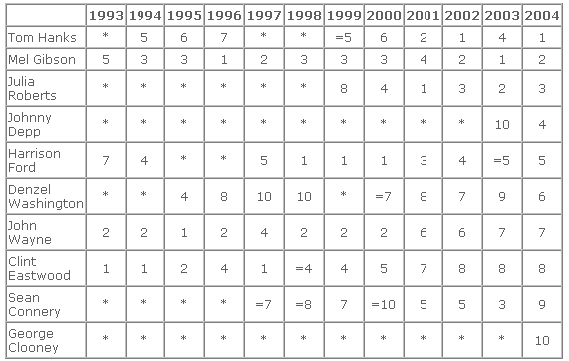 * Not in top 10. DROPPED OUT OF TOP TEN THIS YEAR Tom Cruise (#5 in 2003) TABLE 2 WHICH MOVIE STAR IS #1 AMONG DIFFERENT GROUPS? Bases/Groups as listed below: Favorite Movie Star Men: Tom Hanks Women: Tom Hanks People aged 18-29: Johnny Depp Whites: Mel Gibson African Americans: Denzel Washington Hispanics: Johnny Depp Republicans: Mel Gibson Democrats: Tom Hanks Independents: Robin Williams Methodology The Harris Poll? was conducted online within the United States between December 8 and 15, 2004 among a nationwide cross section of 1,015 adults (aged 18 and over). Figures for age, sex, race, education, region and household income were weighted where necessary to bring them into line with their actual proportions in the population. Propensity score weighting was also used to adjust for respondents' propensity to be online. In theory, with probability samples of this size, one could say with 95 percent certainty that the results have a sampling error of plus or minus 3 percentage points of what they would be if the entire U.S. adult population had been polled with complete accuracy. Unfortunately, there are several other possible sources of error in all polls or surveys that are probably more serious than theoretical calculations of sampling error. They include refusals to be interviewed (nonresponse), question wording and question order, interviewer bias, weighting by demographic control data and screening (e.g., for likely voters). It is impossible to quantify the errors that may result from these factors. This online sample was not a probability sample. These statements conform to the principles of disclosure of the National Council on Public Polls. # by Olsen | 2005/01/05 12:53 | 존 웨인(John Wayne)
|
||||