이 글의 문맥을 분석하여 이글루스에 있는 많은 글 중에서 관련성이 높은 글을 자동으로 검색해 낸 결과입니다.
|
+ http://www.hollywoodreporter.com/thr/reviews/review_display.jsp?vnu_content_id=1002465422
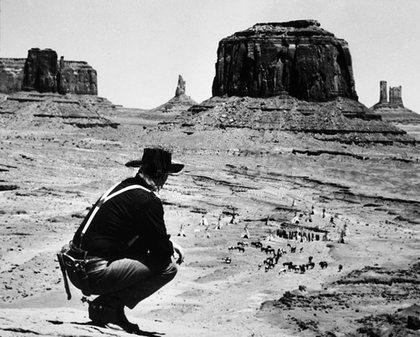
May 10, 2006 John Ford/John Wayne By Marilyn Moss Bottom line: Listen up pilgram! Does it get any better? An entire 90 minutes of witnessing how John Ford and John Wayne made history. 9-10:30 p.m. Wednesday, May 10 PBS American cultural history is rife with famous marriages: Huck and Jim, Walt Whitman and Ralph Waldo Emerson, Ahab and Moby Dick, Natty Bumppo and the forest. But no modern partnership has influenced us as much as the relationship on film (and behind the camera) between John Wayne and his director par excellence, John Ford. If we see Westerns in a specific way -- and we do -- it probably has to do with Wayne and Ford: Male bonding is tough going but steadfast; the film frame is a place for families and renegades to share some space; in the end, the lone cowboy must light out for the territory. These are images Wayne and Ford drove into our collective imagination. As the fascinating (yet sometimes heart-wrenching) documentary, "John Ford/John Wayne: The Filmmaker and the Legend," shows us, the actor and director made history together, and we still live in it. This is great stuff. Director Sam Pollard and writer-producer Kenneth Bowser attempt with much success to understand the complicated relationship between Ford and Wayne. Each is given equal space in this 90-minute account of how they came together, didn't always agree or stay together, yet ultimately shared a binding emotional, artistic tie. The reserve of home movies, film clips, photos and interviews is on display in a bountiful way here. It is really difficult to look away. Ford was the truer renegade of the two, politically independent (and a Democrat), often difficult and insulting on the set (or off), and a poet to the core. He created screen images no other director has truly matched. He put Wayne into those images and made a legend of him (though Wayne had some other wonderful directors: Raoul Walsh and Howard Hawks, to name two.) Sometimes Wayne's conservative political views (and that is putting it mildly) frustrated Ford, but how do you break away from your alter-ego? The documentary shows us how Wayne and Ford's connectedness on and offscreen constituted a saga of artistic greatness and new definitions in just how the film frame could tell American moviegoers about themselves and their histories. There is much here of the legendary expanse of Monument Valley, where Ford often placed Wayne and other members of his stock company, came to represent just how vast and unspoiled our country could be. Sometimes Ford celebrated the sadness that it didn't always turn out fine. Some wonderful interviews with the two men solidify their legendary status. Also, interviews with Patrick Wayne, Dan Ford, Peter Bogdanovich, John Milius, Mark Rydell and Martin Scorsese add depth, even though clips from such Ford classics as "The Searchers," "She Wore a Yellow Ribbon" and "Fort Apache" say much more. Now we know more about the 14 films Wayne and Ford made together over 23 years. They will last lifetimes and then some. AMERICAN MASTERS: JOHN FORD/JOHN WAYNE:THE FILMMAKER AND THE LEGEND PBS Thirteen/WNET and Warner Bros. Credits: Teleplay-producer: Kenneth Bowser Director: Sam Pollard Co-producer: Brian McDonald Editor: Steven Wechsler Original music: Thomas Wagner Supervising editor: Sam Pollard Directors of photography: Michael Chin, Jefferson Miller Narrator: Sydney Pollack + http://www.variety.com/review/VE1117930457?categoryid=32&cs=1 Posted: Tue., May 9, 2006, 1:18pm PT John Ford/John Wayne: The Filmmaker and the Legend (Documentary -- PBS, Wed. May 10, 9 p.m.) Produced by Thirteen/WNET. Executive producer, Susan Lacy; series producer, Prudence Glass; producer, Kenneth Bowser; co-producer, Brian McDonald; director, Sam Pollard; writer, Bowser. Narrator: Sydney PollackSydney Pollack. By BRIAN LOWRY PBS' 'American Masters' takes on the relationship between John Wayne and John Ford in documentary 'The Filmmaker and the Legend.' "American Masters" kicks off its 20th season with a top-notch production about the intriguing relationship between John Ford and John Wayne -- a collaboration that yielded 14 movies, including such classics as "The Searchers," "The Man Who Shot Liberty Valance" and "The Quiet Man." In this no-holds-barred documentary of the kind Ford would have admired, the focus is largely on the director, who discovered Wayne but in later years saw the balance of power shift to the star. If nothing else a treat for the clips, it's a well-spent 90 minute for film buffs. Ford was already an A-list director when he began championing Wayne, leading to the actor's breakthrough role in the 1939 Western "Stagecoach." Still, writer-producer Kenneth Bowser also chronicles how Ford often verbally abused Wayne, who endured the barbs even as he rose from bit player to star to American icon. Gradually, Wayne's own celebrity and power mushroomed, spurred in part by his performance in Howard Hawks' "Red River," prompting Ford to comment that he had no idea the "big sonofabitch" could act that well. In their later pairings, it was Wayne's box office clout that allowed an aging Ford -- who indulged in drinking binges whenever he finished a movie -- to make a highly personal project such as "Quiet Man." Yet through it all, Wayne remained deferential toward Ford, even when the director bizarrely showed up uninvited on the set as Wayne directed "The Alamo," plopping himself in the director's chair and offering unsolicited advice. Liberally featuring memorable scenes from Ford's filmography, Bowser and director Sam Pollard pepper the documentary with the customary array of interviews, tracing the political rift between the two (Wayne was an ardent conservative and anti-communist, Ford an outspoken opponent of McCarthyism) as well as Ford's WWII service while Wayne was back home cranking out features. What's undeniable is that in Ford's favored shooting spot of Monument Valley, the star who became a patriotic symbol and the autocratic director affectionately known as Pappy forged an enduring image of the American frontier at once stirring and ambivalent. Indeed, "The Filmmaker and the Legend" itself employs a recurrent theme in Ford's work, seeking to separate myth from fact, while nevertheless exulting in Ford's towering directing accomplishments and Wayne's underrated acting talent. To sum it up in the kind of tough, martial language both men would surely appreciate: Mission accomplished. Camera, Michael Chin, Jefferson Miller; editor, Steven Wechsler; music, Thomas Wagner. 90 MIN. + http://www.calendarlive.com/tv/cl-et-masters10may10,0,3367327.story?coll=cl-tv-features TELEVISION REVIEW John Ford, meet John Wayne "The Filmmaker and the Legend" shows that the men who shot "Liberty Valance" weren't as alike as you might think. By Robert Lloyd, Times Staff Writer The PBS series "American Masters" begins its 20th anniversary season tonight with "John Ford/John Wayne: The Filmmaker and the Legend," an engaging dual critical biography of the director and the actor whose names are as tightly linked as any in moviedom. Ford, called "Pappy," and Wayne, known as "Duke," made more than a dozen films together, most of them westerns, including "Stagecoach," "Fort Apache" and "The Searchers," that are among the best films Hollywood ever produced, transcending genre to become something deep and complex and unpredictable. As masters go, you can't get any more obviously American than Ford (born Feeney) or Wayne (born Marion Morrison), who after the eagle, the flag and those heads up on Mt. Rushmore is possibly the next closest thing we have to a national symbol. (For good and for ill.) But, as this film relates, they were quite different men in outlook and politics, whose Americanism took radically different shape (until late in Ford's life, when Vietnam War protests turned him increasingly conservative). Directed by Sam Pollard (longtime Spike Lee editor) and written by Kenneth Bowser ("Easy Riders/Raging Bulls"), the film isn't a complete examination of the work or life of either man but a look at what each brought out in the other across the course of their long and often spiky friendship and films together. The emphasis falls slightly more on Ford, who made the frame that made sense of Wayne ? in that first look at him in "Stagecoach," as the camera rushes up to meet him, a star is born ? and was in fact the larger, more troublesome and demanding personality. (Wayne, by all accounts, at least by all accounts here, was a generous, gregarious and exceptionally good-tempered man.) At the same time, it's Wayne you want to look at. For all his famous "manliness" ? of which talking head John Milius speaks approvingly, though Martin Scorsese wonders more trenchantly what that actually means, "to be a man" ? there is a softness to him that takes the edge off him and gives even the most unlikable of his characters a human edge. (Ford too was reputed to be deeply sensitive beneath his hard-to-penetrate exterior and autocratic distancing strategies.) Commentators consistently speak of Wayne's beauty and grace; critic Richard Schickel calls him "absolutely gorgeous," and this is borne out by some striking pictures of the actor in his youth. Along with Scorsese and Milius, there are comments from directors Peter Bogdanovich and Mark Rydell (who directed Wayne in "The Cowboys"); three Ford biographers; critics Schickel and David Thomson; various surviving members of the "Ford Stock Company" that the director carried from picture to picture; and descendants of Ford and Wayne. Each has lived with these films until they are like family. The prints of Ford's films as excerpted here are all pristine and striking; even when they lack narrative context, the pictures have a strong emotional effect and make you want to sink yourself into the body of work for a week or a month or a year. 'American Masters' Where: KCET When: 9 to 10:30 tonight Rating: TV-G (suitable for all ages) # by Olsen | 2006/05/12 18:51 | 존 웨인(John Wayne)
|
||||