이 글의 문맥을 분석하여 이글루스에 있는 많은 글 중에서 관련성이 높은 글을 자동으로 검색해 낸 결과입니다.
|
+ http://living.scotsman.com/index.cfm?id=1367612006
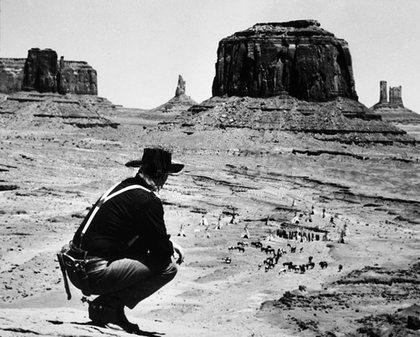
Sat 16 Sep 2006 Whatever happened to the heroes?STEPHEN HUNTER FIFTY YEARS AGO, THE REIGNING Hollywood action hero was a onetime college football player who, in his greatest role, shot the eyes out of a dead Indian, scalped another, called his young sidekick "Blankethead" and didn't get the girl. He ended up exiled, alone, to wander between the winds. Our last shot of him shows the door of civilisation slamming shut, with him still on the outside. That was, of course, John Wayne in John Ford's great The Searchers of 1956, and how long ago it seems. There's no-one now who can stand next to him, but few would want to. Wayne was, in words not invented for him by DH Lawrence but so appropriate, "hard, isolate, stoic and a killer". That sort of tendency toward destruction has all but left the screen now, though it had a long run. As late at the 1970s, Clint Eastwood could build a major career out of a stoic, lonely killer named Dirty Harry and become iconic for his willingness to shoot to kill. He had something else as well, and it's the missing ingredient from today's movies - he knew it was all right to be hated. Hollywood historian David Thomson once called Wayne "the crown prince of difficult men". The stars of his generation knew that the price of heroism, of domination, of certitude, of command, was loneliness - or possibly, since they were so disconnected from their emotions they'd never acknowledge such a thing - aloneness. Look at Gregory Peck in, say, Twelve O'Clock High or Clark Gable in Command Decision, two movies of leadership agonistes set against the strategic bombing missions of the Second World War. In both cases - you could add dozens more - they were men who made decisions that cost other men their lives; they were hated, even loathed; they lived and drank alone. Their courage wasn't physical, it was almost metaphysical. They had the strength within themselves to ignore (though not really; underneath it hurt) the will of the consensus and pleadings for such shady attributes as "compassion" and "humanity." They knew the job came first. That certitude has vanished from many places, but nowhere more vividly than the top of the male star pile in Hollywood. Mel Gibson, who played an action hero, seems to have morphed into director, producer and madman, melting down in a pool of seething angers and resentments. Then there's Tom Cruise, recently dumped by Paramount for (1) personal oddnesses and (2) delivering a movie that may only make $400 million worldwide when everyone knew it should have made $500 million. Down but not out, each actor, you can bet, will hasten to a film highlighting redemption, earnestness, decency and love of fellow man. Don't bet on either's next movie to co-star a submachine gun. In short, they're no longer going to be John Ford heroes but Frank Capra heroes. So who's left? Almost nobody. Eastwood is too old, Arnold is too gubernatorial. Harrison Ford is ancient, Sylvester Stallone too kitschy as well as too old. Let's look at a younger generation: Matt Damon? Only joking. Ben Affleck? Too pretty, really. Leonardo DiCaprio? Again, I joke. Mark Wahlberg? Hmmm, we'll have to wait and see. Where have all the action heroes gone? They certainly haven't gone to be soldiers; no, they've gone to be sensitive, not so much in the touchy-feely way, but in that way that strikes at their essence. They no longer dominate. That's really what the action hero had in spades, and, according to the script, it made other men fear, respect and obey him; and it made women fear, respect and obey him. (You'll note that love had nothing to do with it.) In one sense, he was abusive. Look at The Searchers through a lens of modern revisionism and you see quite a bit of ugliness in Wayne's great Ethan Edwards. He was racist, he was a bully, a tyrant, the father a son could never impress. Quick to anger, slow to forgive, given to spasms of violence. Perhaps Ford's last best message to us was the ferocity by which, through Edwards, he de-idealised the hero. It was as if, like Wayne, he sailed into a mellower old age parodying and sweetening the rage that had made him so great, yet so distant, but not before he told us: These men were great. And they were necessary. And they were heroic. But they were also mean, cruel and masterful and dominating, and if you got on their wrong side, they made you pay. Today's stars need love. They don't want to be feared, they want to be hugged. They don't want to shoot anyone, if possible; they certainly won't beat a confession out of a suspect or verbally rip the head off a kid who's new to the unit and trying hard. Their anger is well managed. They never get even, they don't punish, they see the folly of vengeance, they inflict pain only on special occasions. (Last year's Sin City was one such occasion, where the point of the film was its removal from a moral spectrum, thus allowing its brutish heroes the freedom to torture, as each did.) Only a few boys seem to have the man-junk that can get them through the heavy lifting of a hero's role. Chief among these is Samuel L Jackson. He's in the one with the snakes. In fact, he is the one with the snakes, for without his anchoring presence in the lighter-than-air Snakes on a Plane, the whole thing blows away like a broken kite. In the film, Jackson seems to have beamed in from the 1950s. I think the Duke would approve. Jackson is discovered with a gun in his hand; it's never far from him throughout. He doesn't talk, he growls. "If you want to live, stay by me." See, it's just not guns. It's also a kind of certitude, a kind of sublime, inbred sense of knowing what to do next. Denzel Washington is almost always given nice rational roles where his handsomeness, debonair manner and brilliant dentition can dominate - but when called upon, he can unleash a serious junkyard dog of rage. In the long-forgotten The Siege, he played an FBI team leader with exactly the right mix of Harvard Business School management smarts and some alley-style true grit, again of a sort that would have made John Wayne all to bust with pride. Another man with that talent and presence: George Clooney. He's got a film noir coming out called The Good German, in which he's investigating clandestine activities in postwar Germany, under the assured direction of Steven Soderbergh. In black-and-white, no less! Clooney has the presence and the strength it takes to play a man who doesn't mind being hated. His best performance came in David O Russell's Three Kings, where he played a disgruntled Green Beret officer in the first Gulf War who finds a shot at a fortune, presses it hard and ruthlessly, but then encounters that terror known as duty, and performs heroically. That's the kind of weight up top that's missing from so many movies these days. Let's try to construct the perfect action hero by combining the best of old and new. We don't want too much subtext, because nobody wants a leader with issues. You just want pure grit, true-blue dedication, toughness but fairness, and you want him to convey the idea that he'll be the first man up the hill and the last man off it. Let's give him John Wayne's eyes. His weren't big, booming, expressive eyes, like some of our more womanly movie boys today, but narrow - hooded, you would say, wary. They'd seen too much; they were quick to register anomalies or vibrations of discontent. They were also wise eyes - they could crackle with fire and beam ever so briefly with love. Let's give him Clint Eastwood's dim little jot of a mouth. He didn't have a booming voice, probably his biggest flaw as an actor (he had to pretend to be all gravelly when he talked, else we'd notice how banal he was when he spoke), but his mouth was just a pucker of distaste. It was the prime signifier of his disdain for what was going on. That stoical, grim, quiet mouth made two pronouncements: I am death, and do not mess with me. It was advice well heeded. For voice, let's go with Samuel L Jackson. What an instrument: He can make you laugh or cry with it, feel his indignation or pain, or just plain scare the living bejeepers out of you. Intensity would have to be Mr Cruise's contribution. Though far from a great actor, Cruise has the movie star ability to manifest one overwhelming attribute. In his case, it's a blazing intensity; his eyes become laser beams, his muscles tighten, his mouth becomes a vice clamped into absolute rectitude. Somehow, if you feel nothing else, you feel his total will. Jaw? This one has to come from Randolph Scott. Anyone remember him, beside you Cary Grant fans? Well, Randolph Scott had the squarest jaw on the planet. It was carved from pure granite. From whom do we take cool? Oh, this is a tough one. Lee Marvin was ultra-cool. Ever see him in Point Blank? What about The Dirty Dozen? With his untroubled demeanour and the sudden economy of action, nobody was cooler than Lee Marvin. Except, maybe, Steve McQueen. Now he was cool. Icy blue eyes, blond hair, but blond in a scruffy OK way, not a beach boy coif. He had a jazz-riff, white hipster's vibration going on that you can see a little of in Daniel Craig, the new James Bond, but nobody has ever been as cool as McQueen in Bullitt or The Great Escape. Finally: grace. The movies love it. A man has to move with confidence and sleekness when he walks, to be an action hero. He has to do everything with style and force and yet there can be nothing forced about it. You might think I'd go for John Wayne, because nobody expressed more than John Wayne in the simple act of moving from here to there. But there was this other man who moved like a leopard, had power to spare but a smoothness and precision in his body as if he'd been an acrobat. He blew everybody off the screen when he moved, and even when he didn't move and wore a suit - I'm thinking of the great Sweet Smell of Success - the poetry of his containment expressed enormous power. The camera loved him and a new generation would discover him. And guess what, he was an ex-acrobat - Burt Lancaster.
# by Olsen | 2006/09/16 15:44 | 존 웨인(John Wayne)
|
||||